
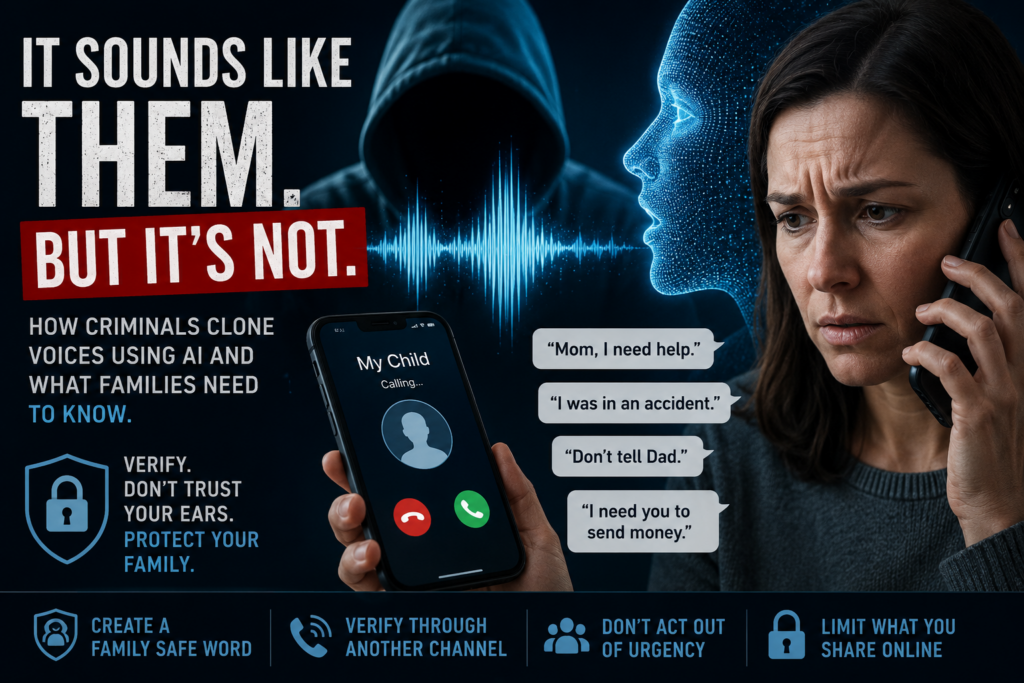
A frantic phone call from your child. A grandparent crying. A spouse saying they’ve been arrested or hurt in an accident. The voice sounds real. The panic feels real. But increasingly, the person on the other end of the phone may not actually be your loved one at all. Introducing AI Voice Cloning.
Artificial intelligence (AI) has made voice cloning technology accessible, affordable, and alarmingly convincing. Criminals are now using AI-generated voices to impersonate family members, executives, government officials, and even law enforcement in scams designed to steal money and sensitive information. Federal agencies including the FBI and FTC have issued repeated warnings as these attacks continue to grow.
For many families, this threat still sounds futuristic. Unfortunately, it is already happening.
What Is AI Voice Cloning?
AI voice cloning uses machine learning and speech synthesis tools to replicate a person’s voice. Modern systems can analyze tone, cadence, pronunciation, pacing, and emotion using only a few seconds of recorded audio.
That audio can come from:
- TikTok videos
- Instagram Reels
- YouTube uploads
- Podcasts
- Voicemail greetings
- School performances posted online
- Public interviews
- Social media stories
Once attackers capture enough audio, AI tools can generate speech that sounds remarkably similar to the real person.
In many cases, the cloned voice is convincing enough to fool close family members. Research published in 2026 found that participants struggled to reliably distinguish AI-generated voices from real human speech in scam scenarios.
How the Scam Typically Works
Most AI voice scams rely on emotional manipulation and urgency.
A common scenario looks like this:
- A scammer finds publicly available audio online.
- AI software is used to create a voice clone.
- The victim receives an urgent phone call.
- The cloned voice claims there has been an emergency.
- The caller pressures the victim to act immediately.
Victims are often told:
- “I’ve been arrested.”
- “I was in a car accident.”
- “Someone kidnapped me.”
- “Don’t tell mom or dad.”
- “I need bail money right now.”
- “Send money immediately.”
The scammer may then transfer the call to a fake attorney, police officer, hospital worker, or government official to make the situation seem more legitimate.
These scams are especially effective because they trigger panic before rational thinking has time to catch up.
Why These Scams Are Becoming More Dangerous
Traditional scam calls often contained obvious warning signs:
- Heavy accents
- Robotic speech
- Poor grammar
- Strange requests
AI changes that.
Attackers can now imitate:
- Your child’s voice
- Your spouse’s speech patterns
- Your boss’s tone
- Familiar emotional expressions
In some cases, the caller ID may even appear legitimate through spoofing techniques.
The result is a scam that feels personal and believable.
The FBI has warned that criminals are increasingly using AI-generated audio and deepfake technologies to target both consumers and organizations.
Families and Older Adults Are Common Targets
Many AI voice scams specifically target:
- Parents
- Grandparents
- Elderly individuals
- Families with active social media use
Criminals know that fear involving children or grandchildren can override skepticism.
Older adults are particularly vulnerable because scammers often exploit emotional trust and confusion during high-pressure situations.
Unfortunately, many victims do not realize they were targeted by AI until after money has already been sent.
Social Media Plays a Major Role
One of the biggest enablers of voice cloning scams is oversharing online.
Short videos posted publicly may seem harmless, but they can provide criminals with enough audio to build a convincing clone. Several reports have noted that even a few seconds of speech may be sufficient for modern AI tools.
This does not mean families should panic or stop using social media entirely. It does mean people should become more intentional about:
- Privacy settings
- Public-facing videos
- What personal details are shared online
- Who can access family content
Warning Signs of an AI Voice Scam
Even convincing scams usually contain behavioral red flags.
Watch for:
- Extreme urgency
- Pressure to act immediately
- Requests for secrecy
- Demands for gift cards, cryptocurrency, or wire transfers
- Calls from unfamiliar numbers
- Refusal to video chat
- Emotional manipulation
- Requests to bypass normal family communication
One of the strongest indicators is when someone insists:
“Do not call anyone else.”
That is usually an attempt to prevent verification.
How Families Can Protect Themselves
Create a Family Safe Word
One of the most effective defenses is surprisingly simple: establish a private family code word or phrase.
The FBI and security experts have repeatedly recommended this approach.
If an emergency call occurs, ask for the family’s safe word before taking action.
Choose something:
- Easy to remember
- Difficult to guess
- Not posted online
Even a highly convincing AI cannot know information it was never trained on.
Verify Through Another Method
If you receive a suspicious call:
- Hang up
- Call the person directly using a known number
- Use FaceTime or video chat
- Contact another family member
Never rely solely on the incoming call.
Slow Down
Scammers depend on panic.
Take a breath. Think carefully. Ask questions.
The faster someone pressures you to act, the more cautious you should become.
Limit Public Audio Exposure
Consider:
- Making social media accounts private
- Reducing public video uploads
- Limiting children’s publicly accessible videos
- Avoiding detailed voicemail greetings
This will not eliminate risk entirely, but it can reduce the amount of audio available to criminals.
Teach Children and Grandparents About These Scams
Awareness matters.
Many victims simply do not know this technology exists.
Families should discuss:
- AI voice cloning
- Deepfakes
- Caller ID spoofing
- Emergency verification procedures
A five-minute conversation today could prevent a devastating scam tomorrow.
The Bigger Picture
AI itself is not the enemy. Voice synthesis technology has legitimate uses in accessibility, entertainment, education, and healthcare.
The problem is that criminals quickly adapt new technologies to commit fraud and social-engineering attacks.
Voice cloning scams are a reminder that in today’s digital world, hearing a familiar voice is no longer enough to guarantee authenticity.
That reality may feel unsettling, but awareness and preparation still remain powerful defenses.
The best protection is not fear. It is education, verification, and healthy skepticism when emotions are running high.
For families, that starts with understanding that sometimes the voice on the phone may sound exactly right — and still be completely fake.
Sources and References
- Federal Trade Commission (FTC) – Voice Cloning Harms
- FTC Voice Cloning Challenge Announcement
- FBI IC3
- Axios – FBI Warning on AI Voice Scams
- The Guardian – Social Media Voice Cloning Risks
- ArXiv Research on Human Detection of AI Voices
You may also find our article on the profile of hackers (19 years old on average) interesting.
#CyberSecurity #AIScams #VoiceCloning #Deepfake #OnlineSafety #CyberAwareness #ScamAlert #IdentityTheft #FamilySafety #CyberTipsGuide #AIThreats #FraudPrevention